
We present Waypoint-2: a real-time video world model trained on gameplay and egocentric real-world video that generates interactive 720p video from text, keyboard and mouse input on consumer GPUs. Waypoint-2 is built on Separable Causal Diffusion (SCD), which splits a causal video diffusion model into a deep frame-causal encoder that runs once per frame and a lightweight decoder that attends only within the current frame and runs at every denoising step. This split moves most of the model’s capacity out of the per-step cost, so a larger model fits within a fixed frame-rate budget. It also enables a training curriculum that starts with text-to-image pretraining of the decoder and moves on to video, first bidirectionally and then causally. On an RTX 5090, Waypoint-2 generates 720p video at 75 FPS including decoding. Measured with the same benchmark, it is faster than Waypoint-1.5 on every GPU we tested despite its larger model and higher resolution, and it follows keyboard and mouse input more closely.
- 75
- FPS on RTX 5090 (incl. decoding)
- 1.49B
- Parameter separable causal DiT
- 720p
- Interactive streaming resolution
- Full
- Text, keyboard & mouse conditioning
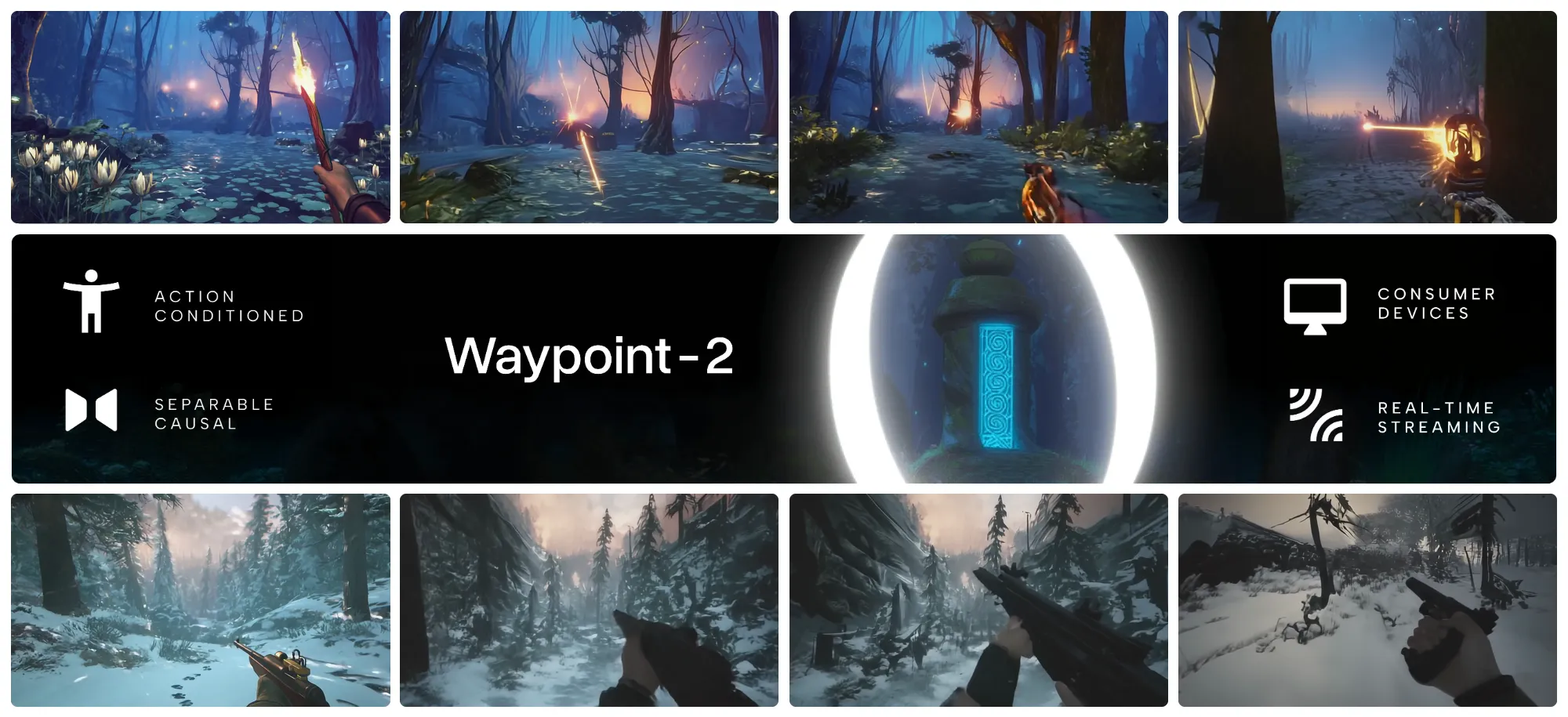
Autoregressive Rollouts
Real-time 720p gameplay generated by Waypoint-2 on a single consumer GPU, conditioned on text, keyboard, and mouse input.
Architecture
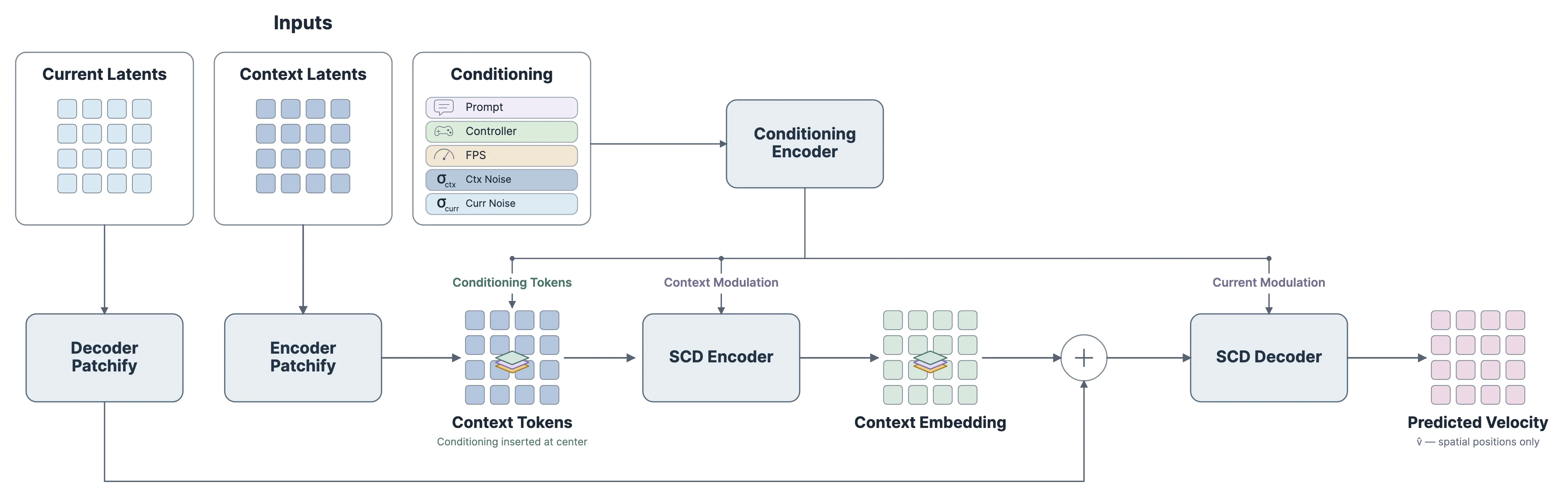
Waypoint-2 is built on Separable Causal Diffusion (SCD). A deep frame-causal encoder reads the past frames, controller input, and text prompt and runs once per frame, with its keys and values cached; a lightweight decoder attends only within the current frame and is the only part that runs at every denoising step. Capacity placed in the encoder is paid for once per frame rather than once per step, so a larger model fits the same real-time budget.
Training Curriculum
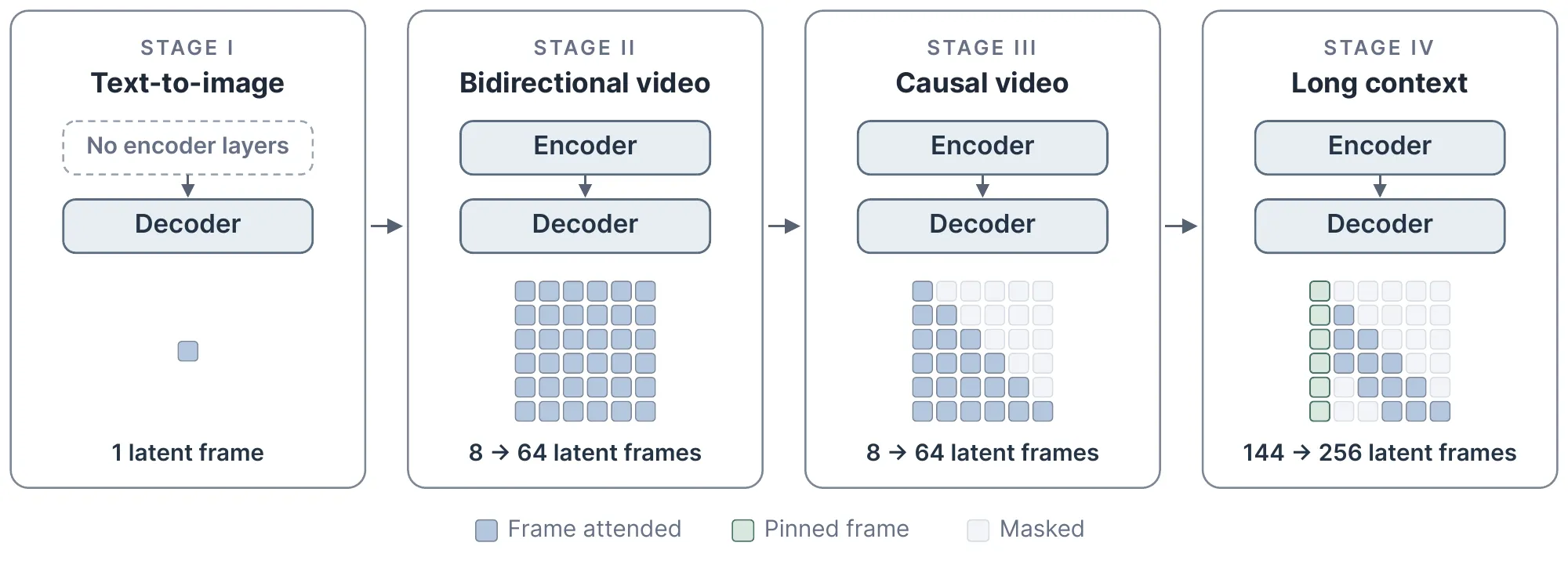
Waypoint-2 is trained in four stages, from single images to long causal rollouts: text-to-image pretraining of the decoder, bidirectional video, causal conversion, then long context with pinned frames.
Performance
Throughput across consumer GPUs, in video frames per second (four per latent frame), measured with the Waypoint-1.5 benchmark in BF16 from an empty cache, without decoding. Waypoint-2 is faster than Waypoint-1.5 on every GPU despite a larger model and higher resolution. The H200 is a datacenter GPU, shown for reference.
| GPU | Waypoint-1.5 | Waypoint-2 (720p) |
|---|---|---|
| RTX PRO 6000 Blackwell | 87.76 | 123.42 |
| RTX 5090 | 66.28 | 89.80 |
| RTX 4090 | 66.60 | 71.67 |
| RTX 3090 | 21.60 | 35.12 |
| RTX 3070 | 14.45 | 20.50 |
| RTX 3060 | 8.80 | 14.28 |
| H200 (datacenter, for reference) | 168.86 | 234.80 |
Text-to-Image Pretraining
Stage I trains the decoder and text pathway as a standalone 720p text-to-image model — before the encoder has any layers — so the decoder learns to generate images before it ever has to continue video. Quality is measured on 10,000 held-out prompts (50 steps, guidance scale 5).

| Model | FID ↓ | SigLIP 2 ↑ |
|---|---|---|
| Real images through the autoencoder | 1.49 | 7.51 |
| Stage I decoder | 10.29 | 8.55 |
BibTeX
If you use Waypoint-2 in your research, please cite:
@misc{overworld2026waypoint2,
  title         = {Waypoint-2: A Separable Causal Video World Model for Real-Time Streaming on Consumer Devices},
  author        = {Rajit Rajpal and Shahbuland Matiana and Liew Wei Pyn and
                   Anmol Agarwal and Ryan Craig and Andrew Lapp and
                   Jerry Xiong and Mithun Hunsur and Scottie Fox and
                   Chris Foster and Elizabeth DaCruz and Carson Poole and
                   Irene Park and David Rossi and Spencer Frazier and
                   Louis Castricato},
  year          = {2026},
  eprint        = {2610.XXXXX},
  archivePrefix = {arXiv},
  primaryClass  = {cs.CV},
  url           = {https://arxiv.org/abs/2610.XXXXX}
}